
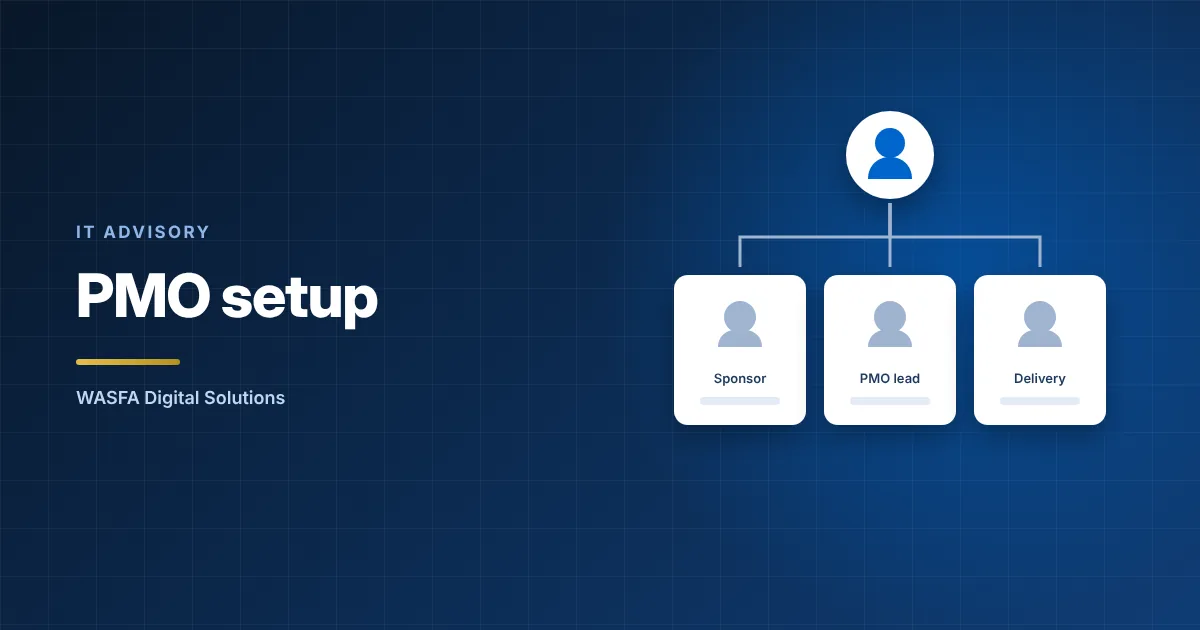
PMO setup for technology programmes follows a fixed order: agree the mandate and level of control first, then governance, a minimum set of templates, reporting, people and vendor obligations, and finish with a 90-day start plan. A project management office (PMO) is a management structure that standardises project governance and makes it easier to share resources, methods and tools. The PMO setup checklist below follows that order.
Each block ends with a “Done when” line. If you cannot say the line is true, the block is not finished. This PMO setup checklist suits a first PMO and also works as a review of an existing one. Items marked as judgement are our opinion. The definitions come from PMI and PeopleCert publications listed under Sources.
Terms used in this PMO setup checklist
- Programme. PMI’s Standard for Program Management (fifth edition, March 2024) presents a programme as the way related projects are united to create more benefit than they would deliver alone. PeopleCert describes MSP (Managing Successful Programmes) as a structured approach to delivering complex programmes, with guidance on governance, vision, leadership and benefits realisation.
- PMO. The PMBOK Guide describes a PMO as a management structure that standardises project-related governance processes and facilitates the sharing of resources, methodologies, tools and techniques. PMOs differ widely in how much control they exercise, which is the first choice in PMO setup.
- PRINCE2. A project management method that PeopleCert describes as built on seven principles, seven practices and seven processes. A PMO can support projects run on PRINCE2, PMBOK-based methods or agile delivery. The PMO is a structure, and choosing the method is a separate decision within PMO setup.
1. Mandate and scope
PMO setup starts with the mandate, which is what gives the office its remit and authority.
- Write the problem the PMO exists to solve in one sentence, in the sponsor’s words. Common candidates are no single view of projects, scope that grows without a change decision, risks that surface late, and unclear decision rights.
- Name an executive sponsor who can approve the PMO’s decisions without a second meeting.
- Set a threshold for what must report to the PMO, such as budget size, number of departments involved or dependence on an outside vendor.
- Choose a level of control. PMI describes three PMO types by degree of control.
| PMO type | What it does | Control | Fits when (judgement) |
|---|---|---|---|
| Supportive | Offers templates, best practice, training, access to information and lessons learned | Low | Project managers are capable and need consistency more than oversight |
| Controlling | Requires projects to follow set methods, templates and governance | Moderate | Quality varies and leadership needs comparable reporting |
| Directive | Manages projects directly | High | Delivery capability is thin, or one programme is risky enough to need a single accountable team |
Done when a one-page charter states the problem, sponsor, scope threshold and PMO type, and the sponsor has signed it. The IT roadmap is the natural source for the list of initiatives the PMO will govern.
2. PMO governance
- Form a steering committee with named members, a fixed cadence and a written list of the decisions it owns.
- Write down who can approve changes to scope, budget and dates, and at what thresholds.
- Define stage gates, the points at which the sponsor decides to continue, change or stop. Typical points are approval to start, baselining the plan, readiness for go-live and closure.
- Set an escalation path with time limits, so a blocked decision moves up after an agreed number of days instead of waiting.
- Require every change request to be assessed for cost and time before anyone approves it.
Done when any stuck decision can be traced to a named person and a date.
3. Method and templates
- Choose one project lifecycle with named stages, and say which stages may be shortened for small work. A single system rollout does not need the structure of a multi-year programme (judgement).
- PMO setup should start with the smallest set of templates you will actually enforce. A workable set is a business case, a project brief, a plan with milestones, a RAID log (risks, assumptions, issues and dependencies), a status report, a change request and a closure report with lessons learned.
- Agree how agile teams fit. If some teams work in sprints, decide what they report to the portfolio view, for example scope delivered, spend and risks, instead of forcing a waterfall plan on them.
- Take the ideas you need from PMBOK-based or PRINCE2 approaches and leave the rest. Adopting a method’s full paperwork because it exists is a common way to make a new PMO unpopular (judgement).
Done when a new project manager can start work from these documents without a briefing.
4. Reporting and benefits
- Build one portfolio view that shows each in-scope project’s status, spend against budget, top risks and decisions needed.
- Define red, amber and green once, in writing, with tolerances for time and cost. Without definitions, a status colour reflects the author’s mood.
- Fix a reporting calendar with a cut-off date and a named reviewer before anything reaches leadership.
- End every report with the decisions leadership must make, and by when.
- For programmes, name a benefits owner and a measure for each expected benefit, and review benefits after go-live as well as delivery. Both PMI’s programme standard and MSP treat benefits realisation as part of the programme itself, not an afterthought.
Done when leadership can read the report in minutes and knows what it is being asked to do.
5. People and capacity
- Appoint a PMO lead whose authority matches the chosen type. A directive PMO led by someone with no authority over project managers will not work.
- Keep a capacity view of project managers and key specialists across projects, so overload is visible before it causes delay.
- Decide who covers when a project manager leaves part-way through a project.
- Train project managers and sponsors on the gates and templates, not only on the method.
- If you are short of project managers, decide whether to hire, borrow or outsource them. That staffing-model choice belongs in PMO setup, and IT outsourcing vs staff augmentation sets out how to make it.
Done when nobody is allocated more work than the capacity view says they can carry.
6. Vendors and contracts
- Put reporting, RAID-log and escalation obligations into vendor contracts, so every vendor reports in the PMO’s format.
- Keep one integrated plan across vendors with a single owner, and state in each contract which tasks and dependencies belong to whom.
- Name the vendor counterpart for each of your decision points.
Done when a delay on one vendor’s task shows on the integrated plan in the same reporting cycle.
7. Tools
- Use the lightest tool that gives a single portfolio view. A spreadsheet that people keep current is worth more than a platform nobody trusts, and a dedicated tool is easier to choose once templates and reporting have settled (judgement).
- Decide who owns the data and who may edit it.
Done when the portfolio view is updated by the project managers themselves, not rebuilt by hand each month.
8. The first 90 days of PMO setup
| Weeks | Focus | Output |
|---|---|---|
| 1 to 2 | Inventory every project and programme above the threshold, with sponsor, budget and status | Portfolio list with gaps marked |
| 3 to 4 | Agree the charter, steering committee and decision rights | Signed charter and the first steering date |
| 5 to 8 | Introduce the RAID log, status report and RAG definitions on the highest-priority projects | First portfolio report to leadership |
| 9 to 12 | Run the first stage gate and change-control cycle, then review what the PMO is slowing down | Adjusted templates and a 90-day review note |
These weeks are a planning assumption for PMO setup, not a benchmark. A large programme will take longer.
Signs the PMO is not working
Use these signs to check back against the PMO setup checklist.
- Every project is green until the month it is not.
- Templates are completed after the meeting instead of before it.
- No project has ever been paused or stopped at a stage gate.
- Project managers treat the PMO as paperwork and do not ask it for help.
- Leadership requests a separate status update outside the PMO report.
A PMO is not the answer to every project problem. A PMI case-study article on building PMOs makes the same point, and advises starting from the specific gaps and the organisation’s maturity.
Setting up a PMO for technology programmes is as much a question of sponsorship and staffing as of templates. WASNA Digital Solutions provides PMO setup and programme management support sized to the organisation, and the checklist above works whether you build the office yourself or with help.
Talk about setting up or strengthening your PMO
Tell us about the projects or programme you need to govern, where they stand and what leadership needs to see, and we will talk through where PMO setup should begin.
Sources
- The Standard for Program Management, Fifth Edition, Project Management Institute. https://www.pmi.org/standards/program-management-fifth-edition (accessed 2 October 2026)
- Appendix X3, The Project Management Office, in A Guide to the Project Management Body of Knowledge (PMBOK Guide), Project Management Institute (preview via O’Reilly). https://www.oreilly.com/library/view/a-guide-to/9781628256642/appendix_x3.xhtml (accessed 2 October 2026)
- PMO evolution: from the origin to the future, Giraudo and Monaldi, PMI Global Congress paper, 2015. https://www.pmi.org/learning/library/pmo-evolution-9645 (accessed 2 October 2026)
- Building a PMO from the ground up: three stories, one result, Rincon, PMI Global Congress paper, 2014. https://www.pmi.org/learning/library/building-pmo-ground-up-9305 (accessed 2 October 2026)
- MSP (Managing Successful Programmes), PeopleCert. https://www.peoplecert.org/browse-certifications/project-programme-and-portfolio-management/MSP-6 (accessed 2 October 2026)
- PRINCE2 Project Management Foundation (Version 7), PeopleCert. https://www.peoplecert.org/browse-certifications/project-programme-and-portfolio-management/PRINCE2-2/PRINCE2-7-foundation-3579 (accessed 2 October 2026)


