What is RPA? Robotic process automation (RPA) is software that carries out repetitive, rule-based work in digital systems by doing what a person would do at the screen, following fixed instructions. It does not learn and it does not judge. RPA suits stable, high-volume tasks on structured data. It does not suit scanned or free-text inputs, work that needs judgement, or anything that can be handled through a proper system integration.
What is RPA in plain terms?
NHS England’s RPA guidance defines it as software robots that are programmed to emulate human actions and interact with digital systems, following predefined business rules. A widely cited academic editorial (van der Aalst, Bichler and Heinzl, 2018) describes the same idea as tools that operate on the user interface of other systems the way a human would. The point of that “outside-in” approach is that the systems underneath stay unchanged. The bot logs in, reads a field, types into another and moves on. So the short answer to “what is RPA” is a programmable user of existing screens that does not learn or judge.
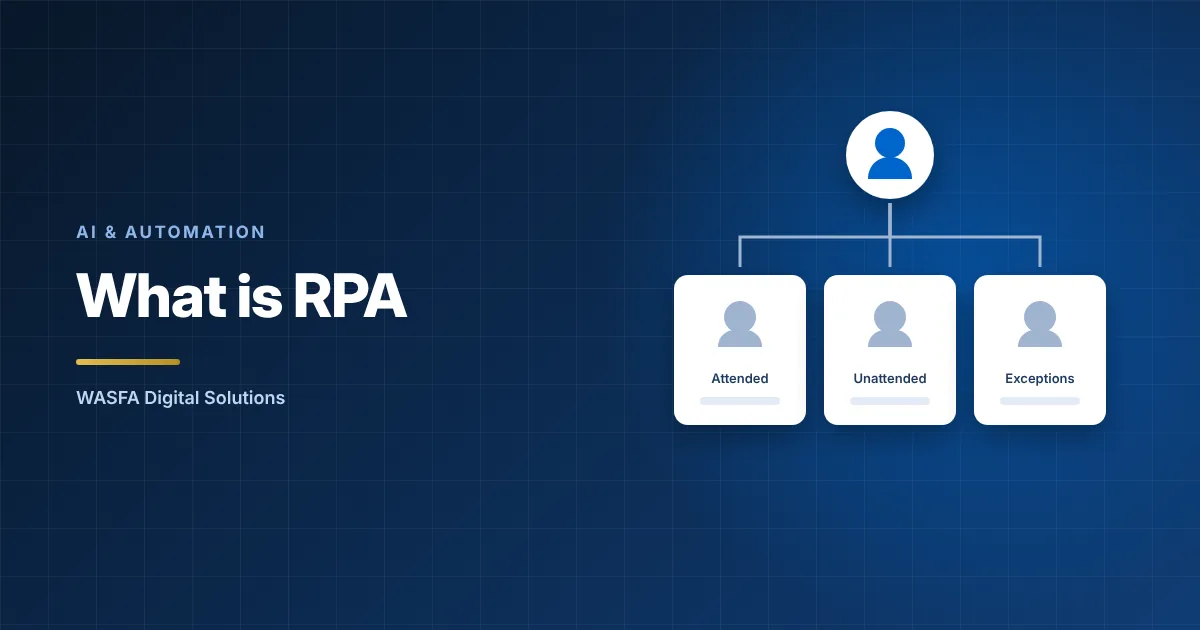
The IEEE 2755 family of standards places RPA inside a wider area it calls software-based intelligent process automation, which also covers AI, cognitive computing and machine learning. The terms below follow that split, and attended and unattended RPA differ in what starts the bot.
- Bot. The software robot that runs the steps. Security guidance from the US General Services Administration treats it like any other network user with assigned access permissions.
- Attended bot. Triggered by a person and working alongside them to finish an individual’s task.
- Unattended bot. Triggered by a schedule or an event and running in the background without a person present.
- Screen scraping. Reading and entering data through the on-screen interface because no integration exists. NHS England calls it a temporary solution to be replaced by properly secured APIs once available.
- Intelligent automation. RPA combined with technologies such as machine learning and optical character recognition (OCR) so that it can handle less structured inputs.
When a product description is vague, ask one question about it: what is RPA actually doing here? Following fixed rules through the screens of other systems is RPA. Reading images or learning from data is OCR or AI.
RPA vs AI and OCR compared
Part of the answer to “what is RPA?” lies in what it is not, so the table sets it beside OCR, AI and workflow automation.
| Technology | What it does | What it handles | Typical task |
|---|---|---|---|
| RPA | Follows fixed rules to move data and operate applications | Structured, digital data | Copying approved invoice data from a spreadsheet into an ERP form |
| OCR and document capture | Turns scans and images into text and fields | Scanned or photographed pages | Reading a supplier invoice image, covered in our note on reading Arabic documents with OCR |
| Machine learning and AI | Finds patterns, classifies, predicts or generates | Unstructured data such as emails and images | Sorting incoming requests, flagging unusual transactions |
| Workflow automation | Routes work between people and systems built for it | Structured requests and approvals | Sending a purchase request to the right approver |
What is RPA not suited to?
Plain RPA cannot read handwritten or scanned paper documents, cannot make independent decisions without AI or machine learning, and struggles with systems whose interfaces change constantly. NHS England is explicit about that boundary. If your project needs those abilities, you are buying more than RPA, and the risks are different. Our overview of AI in Saudi Arabia covers the rules that start to matter at that point.
A five-question fit test
The general question “what is RPA good at?” matters less than whether one of your own processes fits, so run one candidate through these questions. All five “yes” answers make it a good RPA candidate.
- Can the steps be written as rules a new colleague could follow without asking anyone? If a person has to weigh up each case, RPA alone will not do it.
- Is the input structured and digital? Spreadsheets, form fields and system records qualify. Scans, photos and free-text emails need OCR or AI first.
- Does the process rarely change? NHS England warns that processes which change often require changing the RPA scripts, which can cancel the benefit.
- Is there an API or built-in integration? If so, use it. Screen automation is the fallback.
- Is the process worth automating as it stands? High volume and few exceptions make the case. NHS England also advises removing variation and waste before automating, so that only value-adding steps are automated.
Each “no” points to a different fix. For a process that fails, “what is RPA missing?” has a practical answer, which is usually OCR or AI for the input, an integration in place of screen automation, or a simpler process before any automation.
Where RPA fits in Saudi operations
RPA in business is a general technique, so the fit depends on your processes, not on the country. The test is always the five questions above, applied to your own process, and no published Saudi figure will tell you whether yours qualifies.
What is RPA used for in finance and HR?
It is used for repetitive, rule-based steps between systems. In finance it can post already-structured, approved data between systems, assemble recurring report packs or compare ledger and bank entries. In HR and administration it can copy new-joiner or leaver details between internal systems that have no integration.
Four Saudi-specific points to check early
- Arabic and mixed-language screens. Test the tool on your own applications, including right-to-left fields, Arabic and English in the same field and Hijri dates. Do not assume it behaves as it does in an English-only demo.
- Government portals. Before automating one, check its terms of use and whether the authority offers an official integration. ZATCA’s e-invoicing Integration Phase, which began on 1 January 2023 and was implemented in waves, requires the electronic solution to integrate with ZATCA’s systems and generate e-invoices in the required format. That is an integration task, not a screen-clicking one.
- Personal data. A bot that reads employee or customer records is processing personal data, so the Personal Data Protection Law applies to it as it would to a person doing the same work. This is general information, not legal advice. Confirm with a qualified adviser.
- Access and logging. Bots log in with credentials. If the National Cybersecurity Authority’s Essential Cybersecurity Controls (ECC-2:2024) apply to you, bot accounts belong under identity and access management (subdomain 2-2) and its event logging and monitoring (2-12). The same US guidance gives unattended bots their own non-person accounts with least-privilege access.
What it takes to keep a bot running
After go-live, the question stops being what is RPA and becomes who looks after the bot. A bot depends on the screens it was built against. NHS England notes that software updates can make bots fail, including on business-critical processes, and recommends a manual fall-back plan for those. Treat each bot as a small system with an owner, a change calendar that includes the applications it touches, a log someone reads, and a plan for the day it stops. The 2018 editorial describes the typical RPA target as work people do as the “glue” between IT systems. NHS England’s advice to replace screen scraping with secured APIs once available is a reason to plan the proper integration rather than treat the bot as permanent.
Scoping which processes to automate, and in what order, is the first step in the RPA, document processing and workflow work described on WASNA Digital Solutions’ AI and smart automation page, and it is where the answer to “what is RPA?” becomes a plan for your own processes.
Run one process through the fit test with us
If your question is still “what is RPA for?”, pick the manual task your team repeats most. Describe the steps, the systems and the volume, and a WASNA Digital Solutions consultant will say whether RPA, document capture, an integration or no automation at all is the better answer.
Sources
- Understanding RPA. NHS England Digital. digital.nhs.uk. Accessed 2 October 2026.
- RPA in the NHS: guidance for designing, delivering and sustaining RPA, May 2022. NHS England. transform.england.nhs.uk. Accessed 2 October 2026.
- van der Aalst, W.M.P., Bichler, M. and Heinzl, A. Robotic Process Automation. Business & Information Systems Engineering 60, 2018. Springer. link.springer.com. Accessed 2 October 2026.
- IEEE 2755 standards for software-based intelligent process automation. IEEE Standards Association. standards.ieee.org. Accessed 2 October 2026.
- Robotic Process Automation (RPA) Security, CIO-IT Security-19-97, Revision 3, 14 February 2023. U.S. General Services Administration. gsa.gov. Accessed 2 October 2026.
- What is e-invoicing? Zakat, Tax and Customs Authority (ZATCA). zatca.gov.sa. Accessed 2 October 2026.
- Guide to the Saudi Personal Data Protection Law (for controllers and processors). Saudi Data and AI Authority (SDAIA). dgp.sdaia.gov.sa. Accessed 2 October 2026.
- Essential Cybersecurity Controls (ECC-2:2024). National Cybersecurity Authority. cdn.nca.gov.sa. Accessed 2 October 2026.


